
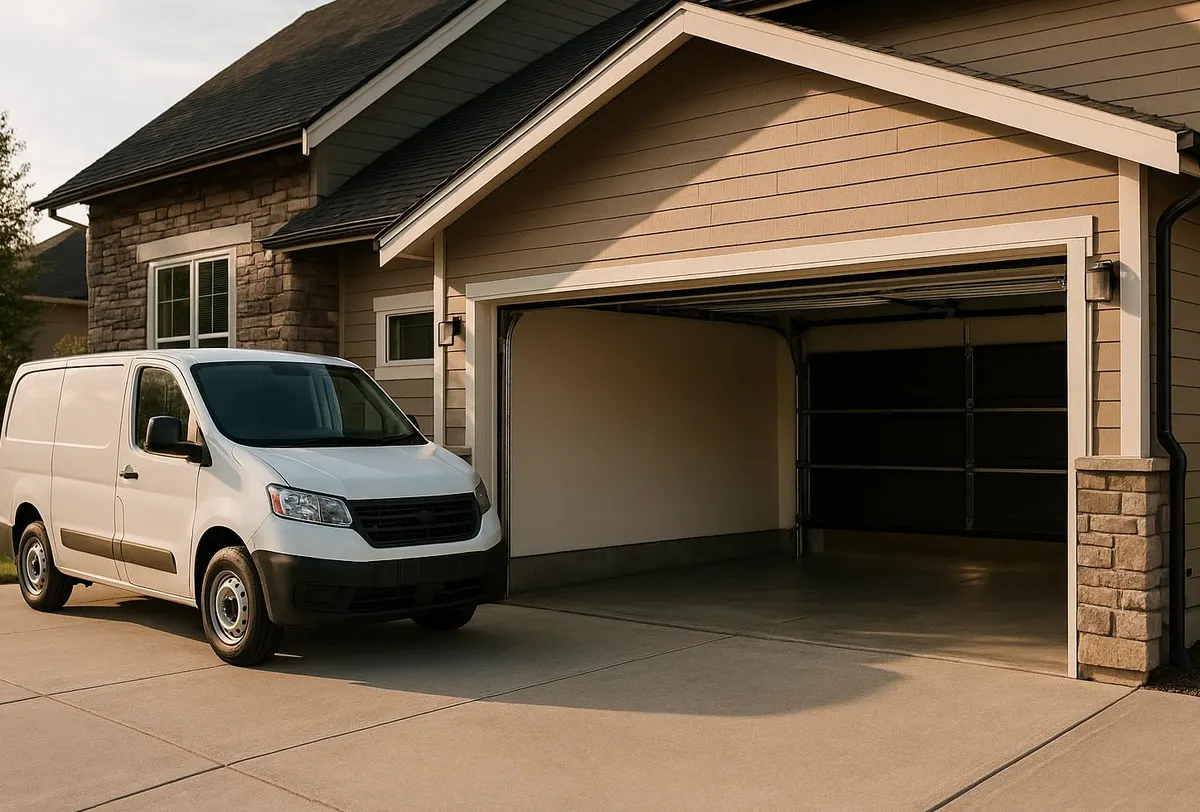
A garage door that won't open rarely stays a one-day problem. Leave it through another month of South Florida humidity and afternoon storms, and a sticky track turns into a bent one, a weak spring turns into a snapped one, and a car that's trapped inside during an evacuation order becomes a real headache instead of a minor one. Garage doors are also the largest moving object in most homes — when they fail, they tend to fail at the worst possible moment, like right before a storm rolls in off the coast.
Before getting into causes, it helps to know what you're actually seeing, because the symptom usually points straight to the fix.
Common Symptoms Homeowners Report
- The door doesn't move at all, and the opener motor is silent.
- The opener hums or runs, but the door doesn't budge.
- The door starts to open, then stops partway and reverses.
- The door opens a few inches, then stalls.
- You hear a loud bang from the garage and the door won't move afterward.
- The door feels unusually heavy when lifted by hand.
- One side of the door looks lower or tilted compared to the other.
The Causes, in the Order a Technician Checks Them
1. Power and Remote Issues
This is the first and fastest check: is the opener plugged in, has a breaker tripped, and does the wall switch work? Humidity and power surges from summer storms can trip GFCI outlets in the garage without anyone noticing. A tech will also swap the remote battery and test the wall button directly, since a dead remote looks identical to a dead opener from across the garage.
2. Safety Sensor Misalignment
If the opener runs but the door won't close, or reverses immediately, the photo-eye sensors near the bottom of the track are the next stop. Humidity and minor settling can nudge these sensors out of alignment over months, and a spider web, dust, or glare from low morning sun can block the beam entirely. The fix is usually just realigning and cleaning the lenses — a five-minute job once it's found.
3. Broken or Worn Springs
A loud bang followed by a door that won't lift, or a door that suddenly feels much heavier, points to a broken torsion or extension spring. Springs cycle thousands of times and are rated for a set number of openings; coastal humidity and temperature swings don't help their lifespan. This is not a DIY repair — torsion springs are under enormous tension and a technician will use calibrated bars and replace both springs in a pair, even if only one failed, since the second is usually close behind.
4. Snapped or Frayed Cables and Worn Rollers
If the door opens unevenly, drops suddenly, or one side hangs lower, a cable has likely slipped off its drum or frayed through. Rollers that have gone stiff or cracked from age and moisture exposure can also bind in the track and throw the door off balance. Replacement means removing the old cable or roller under tension release and re-threading everything to the drum correctly.
5. An Off-Track Door
Wind-driven debris, a car bump, or a door that was forced closed against resistance can knock the rollers out of the track entirely. The door may look visibly crooked or jammed at an angle. A technician checks the track alignment with a level, re-seats the rollers, and tightens the mounting brackets — bent track sections usually need to be replaced rather than hammered back into shape, since a bowed track will just fail again under wind load.
6. Opener Motor or Gear Failure
If everything upstream checks out but the door still won't move, the opener itself may have a stripped drive gear or a worn-out motor. These parts wear gradually, and a chain or belt that's slipping is often an early warning sign before full failure. Depending on the opener's age, this is either a gear replacement or a case for installing a new unit.
7. Humidity Swelling and Rust
In older wood or composite doors, humidity can cause the panel to swell slightly in its frame, creating friction or binding that the opener isn't strong enough to overcome. On steel doors and track hardware near the coast, salt air accelerates rust at hinges, rollers, and tracks, adding resistance that eventually stalls the door. Both call for either hardware replacement or a tune-up that cleans, lubricates, and adjusts the moving parts.
When to Call North Miami Beach Garage Door Pro
If your door won't open and the quick checks — power, remote battery, sensor alignment — don't solve it, stop forcing it. Pulling a jammed door by hand or running the opener repeatedly against a stuck track usually turns a single repair into two or three. Call us for Garage Door Spring Repair if you heard a bang or the door feels heavy, or Off Track Door Repair if the door looks crooked or came off its rails. We'll diagnose it in the same visit, using the same order of checks above, and give you honest pricing before any work starts.
If your door has been working fine but you haven't had it looked at in a while, a Garage Door Maintenance & Tune-Up before the next round of storms can catch a weak spring or a rusting roller before it leaves you stuck. Call North Miami Beach Garage Door Pro today for same-day service across North Miami Beach, Aventura, Sunny Isles Beach, and the surrounding area.